They are often the first piece of jewelry we put on in the morning and the last we take off at night. Fashion earrings have this rare ability to transform a face, elevate a basic outfit, and tell something about us without saying a word. Golden hoops in the sun, bohemian dangles, minimalist studs, graphic ear cuffs: the choice is immense, and that's precisely what complicates the decision. How to navigate this abundance of shapes, materials, and styles? This guide highlights the criteria that truly matter to find the pair that reflects you.
Why are fashion earrings so appealing?
Costume jewelry has long carried a reputation of being 'not serious', reserved for disposable fast fashion accessories. That era is over. French designers now work with gold-plated brass, 316L stainless steel, natural stones, and resin with a care that rivals fine jewelry. The result: durable, elegant, and accessible earrings.
The other strength of costume jewelry lies in its creative freedom. Where high jewelry imposes a certain restraint, fashion dares to embrace bold geometric shapes, unexpected material combinations, and vibrant colors. It's a playground where one can express their personality without breaking the bank and change styles according to their desires.
What are the main types of fashion earrings?
Before choosing, it's essential to know the vocabulary. Each type of earring creates a different visual effect and suits distinct occasions.
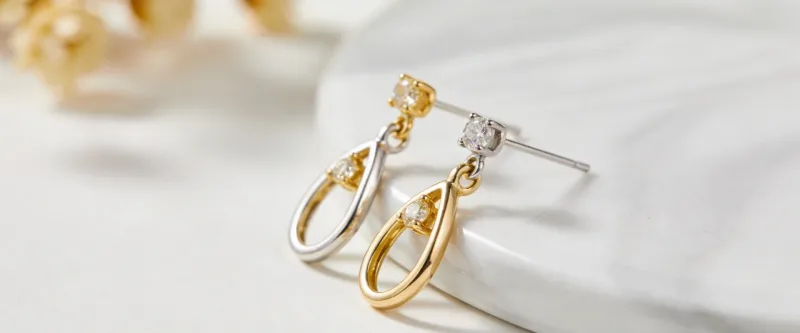
Studs (or ear pins) attach directly to the lobe. Discreet and lightweight, they accompany daily life without ever being bothersome. A stud adorned with a small zircon or a fine stone adds just the right amount of light to the face. It's the quintessential all-purpose model.
Sleeper earrings form a small ring that surrounds the lobe and closes completely, hence their name: they can be worn at night without the risk of losing them. Their slightly retro charm gives them a timeless elegance, ideal for vintage style enthusiasts.
Hoops transcend the ages without ever going out of style. They come in fine and discreet rings for the office or in XXL versions to assert a look. The golden rule with hoops is proportion: the larger they are, the less the rest of the outfit should be loaded with accessories.
Dangle earrings hang below the lobe and add movement. Fine chains, silk tassels, natural stone drops, cascading pearls: they attract attention and visually elongate the neck. It's the ideal model to give character to a simple neckline.
Ear cuffs are the latest addition to the family of ear jewelry. These rings clip onto the cartilage without requiring any piercing. Worn alone at the top of the ear or combined with other earrings, they allow for very current graphic accumulations.
How to choose according to your face shape?
This is the criterion that is most often overlooked, yet it is one of the most decisive. The right pair of earrings creates balance with the features of the face. The basic rule is simple: choose earrings whose shape contrasts with that of your face rather than replicating it.
A round face benefits from being elongated. Long, thin dangle earrings work wonders as they create a vertical line that lengthens the silhouette. Drops, chains, and rectangular models are good allies. In contrast, round hoops and overly discreet studs tend to accentuate roundness.
An oval face is considered the most versatile shape. All earring shapes suit it. Medium hoops, cascading dangles, and sleeper earrings adorned with stones work particularly well. It's a true blank slate.
A square face is characterized by a strong jawline and fairly straight lines. To soften these angles, rounded earrings are ideal. Medium-sized hoops, teardrop dangles, or softly curved sleepers: the goal is to feminize the features without weighing them down.
An elongated face needs width to restore its proportions. Short and wide earrings, bold studs, round sleepers, and small hoops fulfill this role. Long dangles should be avoided as they accentuate the stretching effect.
A heart-shaped face is characterized by a wide forehead and a narrow chin. Earrings that flare out towards the bottom (in an inverted triangle, pear, or chandelier shape) rebalance the volumes by visually filling out the lower part of the face. Medium hoops also work very well.
Materials: Beyond Aesthetics, A Matter of Comfort
The choice of material is not solely a matter of taste. It also involves the durability of the jewelry and especially the comfort of the skin. Because the issue of allergies is not trivial: nickel, the number one allergenic metal in jewelry, affects about 10% of women and 5% of men according to dermatologists. Present in many cheap alloys, it causes redness, itching, and sometimes real contact eczema.
316L stainless steel (known as 'surgical steel') is now the most favored material in quality costume jewelry. It resists corrosion, does not tarnish, and offers excellent skin tolerance. It is also the metal used for initial studs after an ear piercing. Its lightness makes it a great ally for voluminous dangles.
Gold-plated brass provides a visual effect close to real gold for a much more accessible price. Its quality depends on the thickness of the plating: a plating that is too thin (less than 3 microns) wears out quickly and eventually exposes the base metal. Serious creators work with a minimum of 3 microns of gold to ensure good longevity.
925 silver (or sterling silver, composed of 92.5% pure silver and 7.5% copper) offers an excellent balance between elegance and skin tolerance. It tends to tarnish over time, but a simple cleaning restores its shine. Rhodium plating (a thin layer of rhodium) prolongs its brilliance and enhances its resistance to skin reactions.
Titanium and niobium are champions of biocompatibility. Used in medical implants, they cause virtually no allergic reactions. Their cost is higher and their availability in costume jewelry is more limited, but they represent the best option for truly reactive skin.
As for non-metallic materials like resin, wood, porcelain, or cultured pearls, they allow for texture variation while avoiding any allergy risk at the pendant level. It is important to check the composition of the post and clasp, as it is the part in direct contact with the lobe that causes reactions.
How to match your earrings to your style and the occasion?
Costume jewelry offers the flexibility to adapt to all situations. However, one must know how to play with the codes.
For everyday wear, simplicity pays off. Gold-plated studs, small smooth hoops, or discreet sleepers transition from the office to dinner with friends without a hitch. The rule: lightweight earrings that you forget you are wearing, with no risk of snagging on a shirt collar.
For an evening or special event, it's the time to dare long dangles, models adorned with colorful stones, or voluminous hoops. The trick is to make your earrings the centerpiece of the outfit: if they are imposing, lighten the rest (no heavy necklace, fairly understated makeup).
The bohemian style flourishes with raw and organic materials. Feathers, semi-precious stones like agate or turquoise, gold chains, and ethnic patterns create a warm and free universe that pairs ideally with flowing dresses or linen.
The minimalist style focuses on pure geometry: gold bars, fine rings, abstract shapes in smooth metal. No frills, no loud colors. Elegance comes from the line and the material, without excess.
The maximalist style embraces volume and color. XXL hoops, dangles adorned with rhinestones, multiple earrings on the same ear: current trends encourage this play of controlled exuberance. The key is to maintain coherence in tones (all in gold or all in silver) to avoid a cluttered effect.
Layering and Asymmetry: Two Trends to Tame
One no longer necessarily wears earrings in identical pairs. Asymmetry has become established in recent years and shows no signs of retreat. The principle is to wear two different earrings, one discreet and the other more eye-catching, to create a dynamic contrast. A fine stud in one ear and a long dangle in the other: the offset draws the eye without falling into chaos.
Layering, on the other hand, involves stacking multiple earrings on the same ear. Studs on the lobe, a small ring in a second hole, an ear cuff on the cartilage: this personalized composition gives a very contemporary result. To succeed in layering, one must vary the sizes while keeping a common thread (same metal, same color palette). Three to four earrings per ear are enough to create the effect without overloading.
The single earring is the radical version of asymmetry: a single earring worn on one ear. This minimalist choice works very well with a sculptural piece or a striking pendant that doesn't need a duplicate to exist.
Mistakes to Avoid
Several pitfalls regularly arise when choosing fashion earrings. The first is neglecting the weight. Too heavy dangles pull on the lobe, end up causing pain, and damage the piercing over time. If a model appeals to you but feels heavy in hand, it will be even more so after a few hours.
The second pitfall is choosing earrings that are the same color as the top of your outfit. The earring should contrast with the clothing to stand out and catch the light. Gold earrings on a black sweater will have much more impact than black earrings that blend into the fabric.
The third pitfall concerns hairstyles. Spectacular dangle earrings lose all their impact if covered by hair. To showcase them, a bun, ponytail, or hair pulled behind the ears makes all the difference.
Finally, beware of closure systems. A loose butterfly clasp condemns your earrings to end up at the bottom of a bag (or worse, on the street). Lever clasps on sleepers and secure silicone posts offer much better everyday hold.
A final word for those who are still hesitant: the 'right' choice does not exist in absolute terms. Earrings are a very personal, almost intimate piece of jewelry. They frame the face, accompany the gaze, and the smile. The best pair will always be the one you enjoy putting on every morning without thinking twice.