A diamond necklace is one of those pieces of jewelry that transcends decades without ever losing its shine. A symbol of elegance for centuries, it now comes in a multitude of models, from the discreet solitaire to the spectacular rivière. But with so many options, how do you find your way? Between the size of the stone, the choice of metal, and the style of the setting, every detail matters in finding the piece that reflects you. This guide reviews the main models of diamond necklaces and the essential criteria for making an informed choice.
The solitaire pendant: pure elegance
It is the classic of jewelry. The solitaire pendant features a single diamond suspended from a fine chain. Its main advantage lies in its simplicity: it can be worn with both jeans and an evening gown. This model is perfect for those looking for versatile jewelry for everyday wear.
The stone is generally set with a prong setting (four or six small metal claws that hold the diamond while allowing light to pass through) or a bezel setting, which is more protective and streamlined. The former offers more brilliance as it exposes a large surface of the diamond. The latter ensures better everyday security and gives a more modern appearance.
For optimal visual effect, a round brilliant diamond of 0.25 to 0.50 carats is a good starting point. It remains discreet while capturing light remarkably thanks to its 57 facets.
The rivière necklace: when diamonds cascade
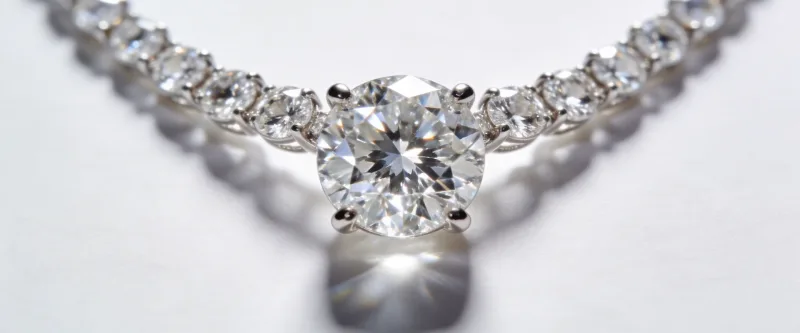
Also known as a tennis necklace, the rivière necklace consists of a continuous row of diamonds set side by side. The visual effect is striking: light reflects off each stone and creates a luminous ribbon around the neck. This model owes its nickname 'tennis' to American player Chris Evert, who interrupted a US Open match in the 1980s to find her diamond rivière bracelet that had fallen on the court.
The rivière necklace is suitable for elegant occasions such as weddings or galas. Some finer models can also adapt to everyday wear. The type of setting used (prongs, bezel, or pavé) influences both the visual effect and the comfort of wearing. The total weight in carats varies significantly from one model to another and directly impacts the budget.
The choker and the collar: boldness close to the neck
The choker measures between 35 and 40 cm. It hugs the base of the neck and is ideally worn with a V-neck or bare shoulders. The choker is slightly more flexible, around 40 cm, giving it a more natural fall.
These two formats highlight the line of the neck and face. They pair particularly well with a central diamond surrounded by small stones or with a geometric pattern. For women who appreciate a bold style, the diamond choker is a statement piece that draws attention without being over the top.
The princess necklace and the long necklace: playing with lengths
The princess necklace falls between 45 and 50 cm. It delicately rests on the upper bust and adapts well to an open neck or over a round-neck sweater. It is undoubtedly the most universal length.
The long necklace, longer (50 to 60 cm), falls more on the bust. Popularized by Coco Chanel in the 1930s with her double-stranded pearl necklaces, the long format adds a touch of elegance and casual chic. Paired with a diamond pendant, it becomes a character piece. The opera necklace (about 65 cm) is the preferred format for evening wear.
Which diamond shape to prefer?
The shape of the diamond directly influences the style of the necklace. The round brilliant remains the most popular choice: its 57 facets ensure optimal brilliance and symmetry. It is the ultimate safe bet.
The princess cut (square shape) appeals with its more contemporary look and intense sparkle. The emerald cut (rectangular with cut corners) evokes a very appreciated retro sophistication in architectural designs. The cushion cut, with its rounded corners, offers a slightly vintage charm that has made a significant comeback in recent years. The pear shape (teardrop shape) gives the pendant a graceful and feminine silhouette. Finally, the oval shape visually elongates the neck and offers an original alternative to the classic round.
No shape is objectively better than another. The choice primarily depends on your personal taste and the style of jewelry you are looking for.
The 4Cs: understanding diamond quality
To assess the quality of a diamond, professionals use a system created in the 1940s by the GIA (Gemological Institute of America). This system is based on four criteria known as the 4Cs.
Carat (weight) measures the size of the diamond. One carat equals 0.2 grams. However, be careful: a heavier diamond is not necessarily more beautiful if its cut is poorly proportioned.
Cut refers to the quality of the cut. It is the criterion that most influences brilliance. A perfectly cut diamond reflects light spectacularly, even if its carat weight is modest.
Color is evaluated on a scale from D (perfectly colorless) to Z (visible yellow tint). For a necklace, a color between D and H offers an excellent appearance to the naked eye.
Clarity measures the inclusions and imperfections of the stone observed under 10x magnification. The scale ranges from FL (flawless) to P3 (inclusions visible to the naked eye). A VS (very slightly included) grade represents an excellent compromise between quality and price.
What metal for the setting?
The metal of the chain and setting significantly alters the appearance of the necklace. White gold is the most common choice for colorless diamonds. Its cool, bright hue accentuates the purity of the stone and gives it a decidedly modern look.
Yellow gold adds warmth and a more classic touch. It recalls traditional jewelry and gives the piece a heritage dimension. Rose gold, on the other hand, is distinguished by its softness and originality. It feminizes the jewelry and creates a delicate contrast with the white sparkle of the diamond.
Platinum offers superior strength and a naturally white color that requires no rhodium plating. It is the noblest (and most expensive) metal for hosting a diamond.
Natural diamond or lab-grown diamond?
This question is increasingly present at the time of purchase. Lab-grown diamonds (also called synthetic diamonds) have exactly the same chemical, physical, and optical properties as natural diamonds. Even a professional gemologist cannot distinguish them without specialized equipment.
Their main advantage is the price: for the same quality (same carat, same color, same clarity), a lab-grown diamond costs significantly less than a natural diamond. It also offers complete traceability and appeals to buyers sensitive to ethical issues related to mining.
On the other hand, the natural diamond retains a stronger heritage value. Its geological rarity and symbolic dimension (a stone formed billions of years ago in the depths of the Earth) justify its higher price for many. Reselling a natural diamond is also easier than reselling a lab-grown diamond, whose value in the second-hand market is still uncertain.
The choice between the two is not a moral dilemma: it depends on your personal priorities, budget, and the importance you place on resale value.
The importance of certification
Regardless of the chosen diamond (natural or lab-grown), certification by an independent laboratory is an essential guarantee of trust. The three most recognized organizations in the world are the GIA (Gemological Institute of America), the HRD (Hoge Raad voor Diamant, based in Antwerp), and the IGI (International Gemological Institute).
These certificates detail the exact characteristics of the stone according to the 4Cs and assign a unique number, often laser-engraved on the diamond's girdle. In France, certification is generally offered for diamonds starting from 0.30 carats. A certified diamond is easier to resell and ensures without difficulty. Conversely, a diamond without certification from a recognized laboratory immediately has its value called into question.
How to adapt your choice to the occasion and budget?
For daily wear, a white gold solitaire pendant with a diamond of 0.25 to 0.50 carats remains the safest choice. It slips under a blouse or over a turtleneck. Discreet yet refined, it withstands the wear of everyday life.
For an engagement gift or a significant birthday, you can upgrade to a diamond of 0.50 to 1 carat set on an elaborate pendant or opt for a beautifully crafted rivière necklace. The prong setting will highlight the stone more for special occasions.
The budget also guides the reflection. Rather than sacrificing the quality of the cut to gain carats, it is better to choose a smaller diamond that is perfectly cut. A 0.30 carat diamond with an excellent cut will produce much more sparkle than a poorly proportioned 0.50 carat diamond. It is the cut that makes the magic of the diamond.
Also think about harmonizing your necklace with your other jewelry. If you wear a white gold engagement ring, a necklace in the same metal will create a cohesive set. And if you like layering necklaces, choose different lengths to prevent them from tangling.
One last piece of advice: take the time to try on several lengths and styles before deciding. A necklace is a piece of jewelry that you wear close to your face. It should enhance your neck, complexion, and personality. The 'right' model is simply the one you will want to wear every day.